Sunday, 28 June 2015

It is now 9 years since the Disability Discrimination Act Part III came into force in 2004 laying out the rights of disabled people. And now in many cases it seems as if that legislation has been forgotten after the initial panic by businesses and the mass marketing by the suppliers of access equipment and access consultants. Suppliers were quick to bring out new products and heavily market existing ones: and quite rightly hat's what they do, find a market and promote heavily. Many Access Auditors wrote very detailed audits picking up minute detail that they listed as inaccessible and requiring an adjustment: and I feel they were often protecting themselves and not being practical, bringing extremely high costs with them. The Business was almost held to ransom with the Act being construed to suit. So many businesses just ignored he Act altogether. Others had audits carried out but took no action to implement the recommendations. Few were taken to court, most actions were settled out of court. I can recall carrying out an audit at a magistrates' court then being call as a witness by someone who could access the building to follow a particular case that was personal to them. And in most cases the Act died.

Now we have fallen into the pattern of new build being designed to comply with the Act and BSI 8300, which lays down and specifies accessible building features but many existing buildings remain inaccessible, although simple adjustments could be made that would make a huge difference.

Remember disability isn't confines to wheelchair users. In fact wheelchair users make up just a small percentage of disabled people. Remember, a disabled person as someone with "a physical or mental impairment which has a substantial and long-term adverse effect on his ability to carry out normal day-to-day activities. This could be related to hearing or vision, learning difficulties, physical impairment that restricts movement or grip for example, shaking or involuntary movement and much more. The Act breaks disability down into 7 categories. And interestingly some disabilities may be brought on by specific circumstances, for example a shock such as a fire alarm sounding might bring on a hear condition or severe asthma.

If you are looking to employ someone who is disabled you might think about having a person audit carried out on their behalf. Or you may look to having a PEEP undertaken. This is a Personal Emergency Evacuation Plan and is a requirement as part of your standard Emergency Evacuation Plan that every business must have for getting everybody out of the building if necessary, that's basically the emergency route signs you have around the building.

Good access for all does make sense, we are now in an age where equality reigns. Where disabled people are now looking for full lives and not spending their time at home. And in most cases access improvements are low cost and obvious. Its always best to ask any disable discuss access with disabled people as they are usually pragmatic and just want to get on with life.

I've been undertaking access audits for more than 10 years and have covered the UK. If you have a concern over accessibility in your business or employ disabled people contact me for advice at access@mikeleahy.com


Tuesday, 26 April 2011

Welsh English Tactile Signs limited stock


SPECIAL OFFER UNTIL DECEMBER 31st 2015
ALL SIGNS £8 incl post in UK send order to ask@mikeleahy.com and we'll give payment details
In contradiction to common belief over 97% of people who are registered blind can recognise tactile signs from a distance but may not be able to read them. Many have blurred vision which will allow them to identify an outline and colour so that they need to know where they should be looking and at what. 

See more at   http://accessaudit.blogspot.com/p/tactile-signs.html
We have a selection of the most common tactile signs on our separate page. Take a look. We have made them as cheap as chips so there's no reason not to use them in your business. Tactile signs are one of the most visual adjustments you can make and help not only visually impaired people but everyone because they are designed to be easily identified and read.

All tactile signs comply with legislation and best practice. All, unless otherwise stated are bi-lingual in Welsh & English. All have raised text and symbol (where applicable) and bi-lingual Braille.


All signs are in blue, unless otherwise stated, and have  contrasting white text, symbols and border so that they are easy to identify.There is an indent raised white arrow head marking at the beginning of the Braille so that it can be easily identified. All signs are made of a durable long-life plastic, vacuum formed to be usef both indoors and outside. They come with a self-adhesive peel-off backing sitable for most surfaces but can be screwed for added security.

Signs should all be located at a standard height of 1750mm from floor level so as to be easily distinguished and at a suitable height for both tall people and wheelchair users.


There are many other access issues associated with sight impairment and the Access Audit Co can help and advise you on overcoming this. Call 07976 827959 for a realistic and pragmatic approach.

Sunday, 2 January 2011

Start the New Year with success in mind


Please listen to this short podcast. If I can help you in your business with disability access, health and safety, selling skills or marketing ideas then call me. The start of a new year is a great time to take stock of where you are and where you want to be.
If you are an average person you'll make resolutions now that will have died by the end of next week. But if you are outstanding and want to succeed by doing average things well then this is a great opportunity.

Monday, 27 December 2010

Braille and other media for visually impaired people

Hi Guys

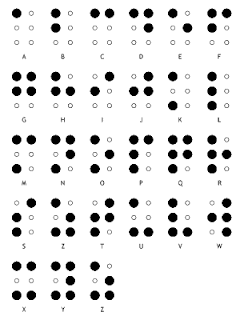
Have you seen those pages with massed of little bumps? Braille was devised in 1821 by Louise Braille, a blind Frenchman. Each Braille character, or cell, is made up of six dot positions, arranged in a rectangle containing two columns of three dots each. A dot may be raised at any of the six positions to form sixty-four possible subsets, including the arrangement in which no dots are raised. For reference purposes, a particular permutation may be described by naming the positions where dots are raised, the positions being universally numbered 1 to 3, from top to bottom, on the left, and 4 to 6, from top to bottom, on the right. For example, dots 1-3-4 would describe a cell with three dots raised, at the top and bottom in the left column and on top of the right column, i.e., the letter m. The lines of horizontal Braille text are separated by a space, much like visible printed text, so that the dots of one line can be differentiated from the Braille text above and below. Punctuation is represented by its own unique set of characters.
Almost two million people are suffering from sight loss to one degree or another. That's about 1:30. And the majority have gradual sight deterioration through Age-Related Macular Degeneration. But there are many guiding aids now around to help. Braille is just one of these. Unfortunately there are only about 100,000 people who can read Braille and fewer who write it.
The Access Audit Company have carried out street audits and feel not enough has been done. Possibly through lack of understanding. It certainly isn't due to financial restraints because most aids are low or no-cost, just a bit of clever thinking.
There is some help out on the street including at traffic lights. Put your fingers under the control box and when the lights show red you'll feel a revolving bar,. This is particularly useful for people who can neither see or hear.
You'll notice that it is customary for street furniture, that is signs, lamp-posts, other signs, waste bijns and so on to be close to the kerb or buildings so that there is a clear pathway down pavements. It is now usual now for tables and chairs put out by cafes etc to be cordoned off, usually with cloth or metal panels. Just a bar or rope between bollards is insufficient and in fact I know of a local cafe that has just added the panels as a blind person stumbled over the rope they had in place. With the smoking ban in pl;ace most places now have an outside area so there are more pavement tables and chairs. Unfairly, I think, some councils introduced a ban on tables and chairs to make a clearway for visually impiared people: then they introduced a charge to cafes for putting chairs and tabes back out. Some people might suggest this is a cash-cow!!
There are also tactile slabs with dimples that denote a  crosingg place, such as flush kerbs for wheelchairs and buggies, traffic lights and zebra crossings. Take a look when you are ouit and you'll notice some are light coloured and some dark. The darker ones show safe crossing places.
Interestingly there have been local navigation systems around for some years now and these are improving year on year. Local systems usually work with a hand-help unit that receives from transmitters attached to street lamps and signs. They tell the informer about shops they are passing, road crossings and points of interest. The latest run of satnav technology. And of course these are getting more accurate all the time, now with some down to just a couple of metres.
Shop signs are also often recognizable by shape or colour by us all. This is particularly useful to partially sighted people. Think about  pharmacies with the green cross, the post office symbol which is so easy to recognise.
This still doesn't help many people who have a severe sight loss and I noticed a guy with a white stick standing on the edge of the pavement the other day whilst several people just passed by!! It takes but a couple of seconds to stop and help. I'm sure you do so keep on. When you do don't grab the person by the arm and pull them along, just offer an arm they can hang onto and guide them, talking about any obstacles or problems ahead. Try it and you'll feel good afterwards too. Remember we all need help sometimes in our lives and it's often the small things like taking an extra 30 seconds to help someone cross a busy road or direct to a shop.

Tuesday, 21 December 2010

 
There are approximately 10 million disabled people in Great Britain covered by the Disability Discrimination Act: about 18 percent of the population. There are over 6.9 million disabled people are of working age which represents 19 percent of the working population. Only 50 percent of disabled people of working age are in employment compared to 81 percent of non-disabled people of working age. 76% of disabled people with a higher education qualification are in employment compared with 90% of non-disabled people. Of those with no qualification, 23% of disabled people are in employment compared with 60% of non-disabled people. Disabled people are almost twice as likely as non-disabled people to have no qualification at all. Disabled people are more than twice as likely as non-disabled people to be out of work and claiming benefits. Of the 2.4 million disabled people on state benefits and not in work nearly a million would like to work. The incidence of disability increases with age. Whilst 9 per cent of adults aged 16-24 are disabled, this increases to about 33 per cent in the 50 to retirement age category. In 2004 40% of the English population are over 45, the age at which the incidence of disability begins to increase.

 And here is the rub.
One in every three people either has a disability or has a close relative or friend who is disabled. Office of National Statistics, Census 2001 The estimated annual purchasing power of people with disabilities is £80 billion. Family Resource Survey 2002/2003
That means that the chances are that either you or a friend is disabled, so it's very close to all of us. AND if you have a business then there is around £80billion worth of purchasing that you might be missing out on.
And if they aren't good enough reasons then you have a legal responsibility. So what is holding businesses back from making access better? It seems that many businesses think the work would be too expensive. Others think that it doesn't matter. What do you think?
I believe that you can improve access for most businesses and properties


Visually impaired people often just need a guiding arm


Just back from a trip to Liverpool to carry out a disability access audit for a company before they sign the lease on their office.
While travelling I sat next to a lady who was blind and we had a most interesting discussion. Well, actually she answered some questions I had in the back of my mind.
Most people just associate disability with wheelchair users: they forget those who can't hear or see to well, have learning difficulties, arthritis, are very short or tall, have no feelings through nerve loss or the many other impairments.
Some disabilities are not obvious and some that you think will be, aren't There are also different levels of disability. For example most people who are registered blind can actually see to some degree. They may just be able to see shapes and colours: might only be able to read at a few inches away from their face. I remember a friend who had a guide dog but could read at very close quarters. When she read the paper on the train she'd get comments - so she stopped reading in public. But on one occasion I recall her almost falling over on the beach when she just couldn't see a large piece of driftwood.
My co-traveller told me how difficult it was recognising steps and stairs. and that she'd fallen down a couple of times.There are special slabs that are used to tell blind people when they are approaching steps and stairs. These are called tactile slabs and the one for steps has a corduroy pattern. These are often used in the wrong place which could lead toreal problems. Only last week I saw the corduroy slabs running along a railway platform. This could be mistaken for a step with dire consequences.

Tuesday, 23 November 2010

Have an Access Audit carried out and bring customers in


"There is so much to do here to make the building accessible that we can't afford it!"  "We are on rhe first floor so we can't get disabled people in here"
Both these statements are wrong. Both are said be people who are either mis-guided or don't want the trouble that they imagine disabled people would be. And when you speak about disabled people most think of just wheelchair users.Wheelchair users make up a tiny number. Many have impairments you wouldn't even know about. Look around you now. How many people can you see who have a heart condition, bad ashma, can't walk far or up steps, have poor eyesight or can't hear very well. The list goes on. A bit like an iceberg. We only see the tip.
So you should be thinking about an access audit if you haven't done so already. It's not too late.
Up til now most cases that have been brought against businesses in relation to disability discrimination have been settled out of court and so you don't know about them but it is happening. I think that this is going to change. On the whole disabled people have been patient and understanding. Well! In many cases they don't know their rights and often they don't feel they can make a difference.
An access audit is completed with a report laying out the steps you need to take to make your business accessible to all. Many are written by surveyors and architects and give exact specifications and are couched in technical terms. This is great if being read by some-one with the knowledge. But often the facilities manager or person responsible doesn't undestand and just passes the list onto a builder. When the work is complete they have to rely on the builder that the work is technically correct.
Mike Leahy writes script reports in layman's language that are easily understood and include the reason for the adjustment too. He takes a pragmatic apprioach and often knows of a quick fix or low cost adjustment. He'll also grade recommendations so you can deal with the priorities first and perhaps leave the "best practice" items til last.
If you haven't assessed what is necessary or taken any action do so now. It will ensure you comply with the legisltaion but equally important will broaden your customer base.